
.

Tuesday, October 25, 2016

6 Travel Hacks to save money on accommodation


QT Hotel, Gold Coast, Australia

1. Use your points

We stayed in Denver, Colorado recently using hotel reward points, saving us around $300 a night. It’s beneficial to sign up to hotel chains loyalty programs. Get on their email list as they often have special deals come out for their members such as double points and free upgrades.
It doesn’t always have to be direct with that hotel chain. American Express Membership Rewards have two Hotel Guest Partners. You can transfer your points into your preferred program and book directly with the partner.

2. Access Club Lounges

Some hotel chains, like Ritz-Carlton and Sheraton, have Club Lounges. You may get access to these depending on your program status, or you can purchase a pass with your points.
These club lounges have free food and drinks. We saved a lot of money eating out when we stayed at the Ritz in Denver as we could eat in the Club lounge!

3. Ask for upgrades and best price

Don’t be shy to ask for an upgrade when you check in. We often get upgrades without even asking. Hotel chains will often upgrade you if they have space as they want their customers to have incredible experiences.
Golden Rule – be kind, courteous and friendly. It’s just karma baby!
Ask the accommodation what is the best price they can do. They can often reduce the rate for you if you book directly with them. On our road trip around Australia, we often asked the caravan parks/hotels upon check-in if that was their best price. We’d often get the kids thrown in for free! If you don’t ask, you don’t get.

4. Use Airbnb

Airbnb is my favourite way to book cheap accommodation. Plus, you get to live like a local and have the facilities to cook your food and save more money.
Apartment rentals often come with free Wi-Fi, are in good locations, and other perks, like tea and coffee, use of kayaks and bikes, and a local’s guide to the area.
I stayed in an Airbnb in LA, and the host even offered transfer services to the airport which were on par with Uber prices. She was also a wealth of inside knowledge, and it was way cheaper than staying in a hotel – by at least $1000 in total.

5. Find the deals

Two for the price of one, discounted rates, kids stay for free – there are multiple ways to find cheap accommodation. Travelling outside of peak times will give you the biggest chance.
Stay connected to your favourite hotel chains and search engine providers via email or social media to quickly grab the deals as they come through.

6. Book your travels with points

As outlined in this post, I used the American Express Travel booking service on their website to book flights, accommodation, car rental and even tours. I found their deals very comparable to other sites, if not better – they had some great discounted deals on accommodation!
You can book using points, or a combination of points + pay.  If you use up all your points, and still have more to book, you can pay for whatever’s left with your American Express Card and collect more points for travel!
With American Express Travel Online there are no restrictions, no blackout dates, and no fees. Simple.
For some eligible American Express Cards offer a complimentary Travel Credit, which can be used to book eligible prepaid flights, hotels or car hire when booking with American Express Travel Online.


Source

13 Travel hacks to save money on flights


small plane flights (2)

1. Clear your cache, enable private browsing

Airlines track your behaviour via cookies, which means if you return at a later date to grab that cheap flight you found in your flight search, they’ve noted your interest through the cookies previously and so will, this time, return a slightly higher price for your flight. #cheeky You can get around this by clearing your cache or enabling private browsing.

2. Use a VPN

Flights can be different prices depending on which country you book from. Use a VPN – a Virtual Private Network – which makes it look like you are in another country.
You can select a VPN from the US, UK, Germany, Japan, etc. to find the lowest price and book through that VPN. It may take time, but you could save a substantial amount on flights.

3. Use search engines

Use search engines like Skyscanner, Adioso, and Google Flights who will scan the airlines for you and bring you comparative rates. You can purchase the best deal directly from them. OR, after finding the best deal, go direct to the airline’s website to see if you can get a better deal.
You can then also check to see if you can reduce the price or get free upgrades with your frequent flyer or membership points. Check your favourite airline first. If the price is right, it’s always best to fly your favourites and stockpile those points each time you fly.

4. Use Frequent Flyer or Membership Points

I can’t tell you how many flights we’ve paid for using frequent flyer points. You can collect them each time you fly – as long as you’re a member of that frequent flyer program. Or, you can collect them using our first travel hack – use your credit card to pay for all expenses. You’ll be surprised how quickly they accumulate.
Craig just used his frequent flyer points to pay for his flight to South Australia. We get several flights per year, including international, due to our frequent flyer points.
American Express Membership Rewards program has over 10 Airline Partners you can transfer your points to. We usually try and consolidate our points to Qantas, but our current Card doesn’t have that option – but we can transfer to Velocity (Virgin), which we use frequently.
If there’s a seat available with Webjet, your points can pay for it, or a combination of points plus pay on your American Express Card.

5. Free flight with your credit card fee

When we pay our annual fee each year for our American Express Platinum Edge, we get a free domestic flight on Virgin. Our friend, Mel, has used her one before to visit us on the Goldie – yay!
I used mine the other day for my return flight to South Australia. If you’re paying fees, find ways to make them work in your favour.
Plus, when you create a new account with American Express you get a bonus 10,000 points. You can use those points in multiple ways as outlined in this post.

6. Find hidden airports

Some airlines don’t operate in the same alliance or have a codeshare agreement, which means they might not show up together on flight searches even though the option is available.
TripCombi uses an algorithm to search connections from nearby airports or between two airlines to track ‘hidden airports,’ as the team calls them. These flights can often offer better rates and connections.

7. Follow Sales Days

Some airlines have certain days of the week where they will release their sale fares. For example, Virgin Australia has its Thursday Happy Hour, which is an exclusive sale for discount flights that you can access only by signing up for their email alert and Jetstar has Friday Frenzy with great sales to domestic and international locations each week.
You can also do this through websites like Airfare Watchdog and CheapAir.com, which both offer fare-track alerts that let you know when prices drop.

8. Politely complain

Don’t go looking for things to complain about, but if something legitimately goes wrong on a flight, reach out to the airline to express your disappointment and explain the situation. Often you’ll receive credit.
I complained to Jetstar once about the rude staff, and I received a $100 credit. It wasn’t why I complained; I didn’t even know that would happen.

9. Get bumped

If you’ve got plenty of time up your sleeves, this is one of my favourite travel hacks.
Plenty of airlines overbook their plans with the hopes some people won’t show up. If they’re too full, they ask for bump volunteers. They’ll get you on the next possible flight as well as giving you perks like free flights, credit and accommodation vouchers if the next flight is not until the next day.

10. Set flight alerts

Search Kayak for the flight you want, and check the price predictor.  If the flight is more than 3-4 months away, set a fare alert, and watch the price.
When you find a price that works, try to book it on a Tuesday or Wednesday when prices are typically lower. To make the hack work even more in your favour, head over to American Express Travel and pay the flight with as many points as you have. If there’s a balance left over, use your American Express card to pay for it and collect more points!

11. Buy an upgrade with points

Some seats on each flight are kept aside for frequent flyers to effectively ‘buy’ using points. These can be seven times less than the Points plus pay seats which are available. These are best suited to solo and flexible travellers.
Qantas has the option to bid for your upgrade. The last remaining unsold biz class seats are put to auction with the highest bidder wins! Take your chances!

12. Work for an airline

Craig worked for Delta in North Carolina for two years. We had standby free flights including flights back to Australia. It was such a shame that they only had space remaining in business class!

13. Airline Lounge upgrades

Free food, drinks and Wi-Fi plus TV, desks and comfy chairs away from the chaos. I didn’t even notice my flight was delayed by almost three hours on my return from LAX. I was lapping up the luxury in the Qantas Business Lounge. Check your frequent flyer program status to see if lounge access is included.
American Express grants eligible Card Members two complimentary airport lounge visits each year to the Sydney International lounge.

Source

Monday, October 24, 2016

7 Beautiful Lakes


In this post we share 7 beautiful photos of Lakes. Check them out and then share your thoughts in the comments.

Lake Louise, Banff National Park

Travel Pinspiration

Emerald Lakes, Tongariro, New Zealand

Travel Pinspiration

Taal Crater Lake, Philippines

8190916714_56d44a7cf0_c   

Bear Lake, Rocky Mountain National Park, Colorado

da6c6ad83c5a6028a66e64a72d553b02

Lake McKenzie, Fraser Island, Australia

43947420_0efb70ff7e_o

Lake Malawi, Africa

7761577014_b88ac3dbfe_c

Emerald Bay, Lake Tahoe, California

b571d7e8968c6b1c2045638e7bc0d328                                                                 
What is your favourite lake? Share a link to a blog post featuring a lake and we will PIN it.

Source 

Tuesday, October 18, 2016

How to Travel by Bus in China (Plus Expert Tips)


How to travel by bus in China

When it comes to traveling in China, most tourist opt to either fly or hop on a train. The reasoning is quite simple: flying is fast and trains are cheap.
There are times, however, when China’s massive, intercity bus system is your best option. Perhaps the flights are too expensive or the train is too full. Maybe you want to save a few dollars or you’re heading to a place that isn’t serviced by an airport or train station.
Whatever the reason, if you plan to take a bus in China, this guide should provide everything you need to know before you travel. Since it has ended up being a relatively long guide, I’ve divided this into multiple “chapters” to help make it easy to digest and you can skip to what you want to read using the table of contents here:

If you find this guide helpful, please leave a comment below or share it on social media. Thanks!

Pros and Cons of Taking a Bus in China

 

Pros vs Cons of Bus travel in China

There are a number of reasons why you might want to take a bus in China…as well as a few reasons you would potentially want to avoid it. Over the decade, I’ve seen my fair share of both while traveling on a Chinese bus.
Let’s start by breaking down a few of the reasons that a bus is a good option for tourists:
  • Frequency: Chinese buses often run at a higher frequency than flights in China or trains. Most of the time you don’t have to worry about booking in advance because there will be a bus between two cities that runs every 20 minutes.
  • Convenience: Compared to Chinese airports and train stations, security at a bus station is a breeze. I rarely arrive at a bus station any earlier than 30 minutes before my departure and I still end up waiting for 15 minutes.
  • Station Location: Most of the time, Chinese bus stations are located in the heart of a city as opposed to airports and train stations which are usually on the edge of town. This can not only save you time, it also saves you the expense of a taxi into town.
  • Availability: I have never bought a bus ticket earlier than a day in advance and often I buy it on the day of departure. Unlike flights and trains, China bus tickets tend to have more availability, giving you the flexibility to change your itinerary at a moment’s notice.
That’s what makes China bus travel good. Here’s a bit of what I don’t like about China bus travel:
  • Unreliable Comfort: Sometimes you get a relatively new bus but often you’ll find yourself riding a vehicle that has seen a couple decades worth of use. It’s a gamble you take and sometimes it can be quite uncomfortable.
  • Unreliable Delays: Unexpected delays are possible (or in China, rather probable) no matter what form of transportation you decide to take. Unlike planes and trains, buses usually leave right on time. The difficulty comes with the unpredictability of the roads. I have been stuck in horrendous city traffic for hours, my bus has been stopped on the highway for a security checkpoint, my bus has broken down and I’ve run into road construction delays. It sucks but there’s nothing you can do about it.
  • A Different Kind of Traveler: Buses are the poor man’s transportation, there’s just no way around it. Don’t get me wrong, the people are great, but since it’s not a high-profile means of transportation the rules don’t always get enforced. For instance, smoking: it’s not uncommon to see people smoking on a bus despite numerous signs saying it is forbidden. I’ve also seen a man walk onto a bus carrying a car windshield. No joke. His seat mate was miserable during the entire ride! These kind of things technically aren’t permitted but the rules are much more relaxed on Chinese buses.
Hopefully I haven’t discouraged you from attempting to take a bus in China, I just want to make sure you have a dose of reality. There are plenty of good reasons to take a bus – and I hope you do! – but make sure you set your expectations before buying your ticket.

A Peek Inside a Chinese Bus

If you’ve never had a chance to look inside a Chinese bus and you’re afraid about what you’re getting into, allow me to walk you through the average bus.
Generally speaking, there are two basic kinds of buses in China: the seated bus and the sleeper bus.
Seated Bus: the seated bus is exactly what it sounds like. There are usually two sets of two seats with a middle aisle and all the seats facing toward the front of the bus. As a tall guy, I’ve never had a complaint about the leg room in a Chinese bus but the seats can be somewhat narrow.

Chinese seated bus
Image Credit: Asia Adventures

Most buses have an entertainment system that will play Chinese movies throughout the duration of the journey and most buses have an air-conditioning and heating system (though not all). Your seat will recline slightly but don’t expect a great sleeping position. A few seated buses have a bathroom but often they won’t be available for use (or you won’t want to use them anyway).
All seats in a seated bus are priced equally and are sold on a first-come-first-serve basis and prices are fixed.
Sleeper Bus: A sleeper bus is different in that travelers each have a bed instead of a seat. There are usually three rows of beds with two aisles in between and a bathroom toward the back (which again, may or may not be available for use). There is a top and bottom bed the entire length of the bus.

The inside of a China sleeper bus
Image credit: Earthlooping

Anybody whose height exceeds 5’8″ will have trouble fitting onto one of these beds, as I do. I don’t have the option to hang my feet over the edge since that is somebody else’s bed so I end up having to scrunch up a little.
These buses also usually have an entertainment system, A/C and heating, although it all depends on the age of the bus you’re riding.
Beds are priced higher for the top bunk than the bottom bunk in a sleeper bus.

Getting to a Chinese Bus Station

A typical bus station in China

To the unseasoned China traveler, it seems simple enough to find a bus station, right? Just look up the word for “bus station” in your handy Mandarin phrasebook and tell the taxi driver. Boom! You’re done 🙂

Unfortunately, it’s not always that easy. With the exception of small towns, most cities in China have a number of different bus stations scattered around. One may be a “long distance bus station” while the other is an “International Bus Station.” Often, bus stations are categorized by which direction their buses head (north, south, east or west) or even by which specific city or region they service. The bottom line is that the word “bus station” just doesn’t cut it. You need to know exactly which bus station you want to go to. How do you do this? Here are a couple ways:
  • Travel Guide Books: Often, the best China travel guide books will give details on which bus stations go to which cities.
  • Ask Your Hotel: Chances are they won’t know off-hand, but they’ll be able to ask the appropriate people and then write down the name of the bus station on a piece of paper that you can hand your taxi driver.
  • Ask Your Taxi Driver: Don’t just tell the taxi driver to head to a bus station, tell him specifically which city you’re taking a bus to. In many cases, a taxi driver will know where you should go.

How to Find the Bus Schedule in China
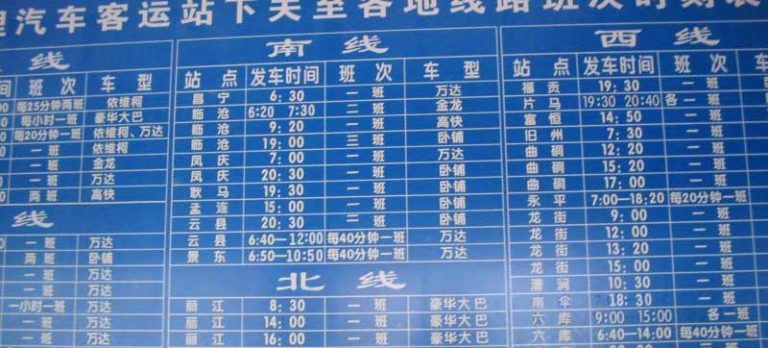
Example of a China bus schedule

In my opinion, the most confusing part about taking an intercity bus in China is figuring out the schedule. Unlike trains and airplanes, you can’t check schedules or even buy tickets online.
For most major intercity connections, China buses commonly depart once every twenty minutes, half-hour or hour. I’m making a major generalization here, I realize, but I’m assuming you’re not wanting to go to some po-dunk village that isn’t on any map.
There are some cases where only a handful or even one or two buses depart each day. In this case you’ll want to have an idea of the bus schedule. I’m going to separate the following recommendations by whether or not you can read Mandarin:
Yes, I Can Read Mandarin! Congratulations, your job will be a bit easier here. Most bus stations either post their schedule on the wall or have an LED board that lists destinations and departures to each city. Sometimes they are translated into English but often they are not.
Since you can read Mandarin, I assume you can also write/type as well. In this case, I’ve had moderate success looking up “[city] to [city] bus schedule” in Mandarin on baidu.com. The results aren’t always up-to-date, but you’ll at least get a general idea of when a bus should depart and how much it should cost.
No, I Can’t Read Mandarin. That’s ok, it’s really not a big deal. As I mentioned in an above chapter, you can always check out a good China travel guide book for bus schedules, although you should make sure that the book is the latest edition.
Other options include just asking the people at the bus ticket counter who can often show you on a computer screen the times of departure and how much a ticket will cost. Alternatively, perhaps your hotel or hostel can give you some good information.

How to Buy Bus Tickets in China

People standing in line to buy bus tickets in China

Since buying bus tickets online has not yet become an option, you’re left with only two options: buy a ticket at the bus station or (maybe) have a proxy do it for you.
China now runs on a “real-name ticket system,” which means that you have to have an official form of ID (your passport) in order to purchase bus tickets. Once your ticket is bought, you can’t transfer this ticket to anybody else without returning it and buying a new one.
Standing in line at a Chinese bus station isn’t my favorite activity in the world, but it’s usually not as bad as, say, standing in line at a train station. Most of the time I arrive on my day of departure, stand in line and purchase a ticket. You’ll want to have cash ready for the purchase since bank cards usually aren’t accepted – particularly foreign credit cards.
It used to be that hostels would offer a ticket purchasing service for guests (I’m not sure how many still offer this). You would need to provide a photocopy of your passport and they’ll charge you a fee, but at least you don’t have to stand in line yourself. An alternative would be to purchase tickets online with a service like www.chinabusguide.com. It’s easy to use but not every city in China is included.

China Buses: Frequently Asked Questions

Frequently Asked Questions

I’ve tried to provide as much information as I can in the above chapter, but I consistently receive questions that I want to answer here in detail.
What can you take on a bus?
The beauty of the Chinese bus is that you can take almost anything you want. People take bicycles, overweight pieces of luggage, instruments…you name it. There isn’t an official weight limit so whatever can easily fit in the underneath hatch is usually permitted.
What are you prohibited from taking on a bus?
Like any other form of transportation in China, there are still some things that you can’t take with you through the security checkpoint of the bus station. This includes: knives, bottles of any kind of liquid, fuel canisters (used for camping in China), lighters, etc. For drinks, you can buy water and sodas at shops inside the bus station.
Can you smoke on a China bus?
While officially prohibited, unfortunately I’ve seen plenty of passengers and even bus drivers smoke on a China bus. Most people wait for a rest stop to pull out their cigarettes but that’s not always the case. If you don’t like smoking, it’s not impolite to ask the smoker next to you to put out their cigarette. Be bold! You’re a foreigner and you can get away with it.
Are there electrical outlets on a China bus?
No. I wish there were but I have yet to see a seated or a sleeper bus with electrical outlets.
Can I get off anywhere along the bus route?
Yes, you can. Just tell the driver exactly where you want to get off (perhaps a specific village or place along the road) and they will stop to let you off.
Do buses pick up hitchhikers in China?
Yes, they do. If you’re out in the boondocks, you can stand on the side of the road and try to wave down a bus. They won’t stop if they’re full, but if they stop just tell them where you’re going on and hop on. You’ll have to pay the driver directly and they’re usually pretty good about giving a fair price for transport.

Bus Tips from a Seasoned China Traveler

Over the many years that I’ve taken buses all across China, there are a few quick tips I’ve picked up that I believe could be helpful to you or even save you money. Hopefully you find them useful!
  • Take the Night Bus: Want to save some money? Take the night sleeper bus to save yourself the money of a hotel. It won’t be as comfortable of a sleep but you’ll manage, I promise.
  • Take Your Own Food: The rest stops for buses can be sketchy at best. Food options are limited and the hole-in-the-wall restaurants are usually a recipe for disaster. Stock up on food before you leave to make sure you can survive on what you have in your own bag.
  • Keep Valuables Up Top: While I definitely recommend you store your luggage in the lower storage compartments, make sure you have all your valuables with you at your seat. I’ve known a couple people who have had items stolen from the below compartments.
  • Bring Your Own Light: This tip is for the overnight sleeper buses. Sometimes you’ll have a light to read by but many times you won’t.

Conclusion: Taking a Bus in China

That’s it! I hope you’ve found this guide to be helpful. I’ve thoroughly enjoyed the experience and adventure of taking a bus across China’s beautiful landscape and I hope you have the opportunity to do the same.
If you have any questions, please let me know in the comments below and if this has been useful please share this guide on Facebook, Twitter, Google+ or any other social media platform. Thanks!

Source

Monday, October 17, 2016

10 Things You Need to Know About Abalone Diving in Mendocino, CA

View from town of Mendocino
The cliffs of Mendocino

My Mendocino abalone diving adventure started with a drive from San Francisco International Airport (SFO) to Mendocino—which was one of the most stunning drives I have ever experienced. I lucked out on the weather and drove out of the city through sun-kissed hills that rose off the bay and up onto the swerving roads encompassed by trees that dappled my path with playful shadows. The road eventually led out to the graceful landscape of golden fields and layers of vineyards as I came into Sonoma wine country. My surroundings were so stunning that I decided that the next time I make the four-hour journey, I will set aside a full day and stay overnight at one of the many inns along the way and perhaps take in some wine-tasting before hitting the coastline. The end of my journey was enshrouded by Sequoias. The road took on a fairytale feeling of towering majesty and pine that swept open to the expansive coastline and sheer cliffs of the Pacific.
The Little River Inn (built in 1857) is set directly on North Highway One, a few miles outside of the charming town of Mendocino and just around the bend from Van Damme State Park. Pulling up felt familiar, almost as though I was visiting a dear friend or family member, and that set the warm and inviting precedent for the entire experience. The inn is ingrained in local history and is still run by the family that started it five generations ago. It’s beautifully managed. Every room features a view of the ocean and modern amenities and is kept with care and thoughtfulness. The place features a chef-run restaurant, a fantastic bar that has changed little since 1939 (you can whale-watch from the bar; they provide binoculars), a spa, a golf course, and even a cottage that sells yarn of every type called the Mendocino Yarn Shop (they teach knitting and crocheting as well).
The diving camp takes place over two days. The first day is a practice run and includes some “classroom” time with the experts from TritonX—licensed guides Josh Russo, Greg Fonts and Greg Shimaura. Many may wonder why a guide is needed when there’s freediving just off the coastline. If it’s your first time freediving, instruction is a must. It’s a whole new ballgame from diving with tanks, as you are relying on specific breathing technique and body control—and the waters can be unforgiving. This is not a hardcore-adventure-travel-type of thing to take on, but it’s definitely not for wimps. I grew up diving, to include freediving, but I was very grateful to have some of the world’s best freedivers guiding me through every procedure, safety and the laws of hunting abalone (yes, they are stringent and the coastline is heavily watched by wildlife officers).
Once you’re back from Van Damme Beach you have the option to learn how to clean and prep what you caught for the day. Having chef Marc Dym on site was a treat, as we also learned the different ways to prep abalone steak and enjoyed a beautiful meal created from our catch. The accompanying wine from Mendocino was a big bonus, and no matter where we were on the property there never seemed to be a lack of stunning views. In a short space of time it was easy to create friendships, and I have every intention of returning.
Here are ten things to know before you go:
Abalone catch in Mendocino, CA

1. You need a license
You must have a State of California Department of Fish and Wildlife fishing license for the days you are hunting abalone. This is to include a Report Card that lists what the details of what was caught, where, when, etc. You can obtain a license from the CVS in Ft. Bragg, a short drive from prime abalone hunting off of Van Damme Beach. You can order them in advance through the CDFW site, but keep in mind delivery may take up to two weeks.
A room with a view at Little River Inn

2. The Little River Inn
There are several places to stay, but I highly recommend Little River Inn. It’s been family-owned for five generations, and every room has a knockout view of the ocean, and you are treated like welcome family.
Free diving equipment provided by TritonX
Freediving equipment provided by TritonX

3. Wet suits should be 7 mm thick
If you bring your own wet suit, it should be at least 7 mm thick. The water is cold, even in the summer months. It should also include a hood, booties and gloves.
Tag your abalone
Tag your abalone

4. Know the rules of how many abalone you are permitted to pull
This season on the California North Coast the annual limit is 18, but only a total of nine can be taken from Sonoma and Marin Counties. It may not be obvious, but you are being monitored and it’s not unusual for the wildlife rangers to do a license spot check.
Whale-watching from Ole's Bar
Whale-watching from Ole’s Bar

5. Whale watch at Ole’s Whale Watch Bar
If you haven’t had enough wildlife after your dive, the best place to get a drink and whale watch at the same time is Ole’s Whale Watch Bar, which is conveniently in the Little River Inn. They even provide the binoculars and the bartenders are excellent.
Rolling hills of Sonoma, CA
Rolling hills of Anderson Valley, CA

6. If you fly in to San Francisco, rent a car and make a day of the drive
The scenery coming out of the city into Marin County and then through the vineyards of Anderson Valley is stunning. You end up on a road winding through striking redwood forest that opens up to a coastline like no other.
Van Damme Beach in Mendocino

7. Forget something? You can pick it up in Ft. Bragg
If you forget anything Ft. Bragg is a short drive away from the primary diving spot of Van Damme Beach and is full of modern conveniences.
The town of Mendocino, California
The town of Mendocino, CA

8. Take some time to visit the town of Mendocino
It’s quintessentially California quaint, with Victorian houses and lovely cafes set on the wild coastline of the Pacific.
Josh Russo of TritonX preps divers

9. Go with professional divers…
…especially if you are remotely new to free diving. This is not a sport to be taken lightly, and even in shallow depths there is opportunity for bad things to happen. Being taught the right way to dive and harvest abalone is imperative not only to personal safety, but also to the future of the abalone population.
Van Damme Beach in Mendocino

10. Sign up for Abalone Camp
Make your experience streamlined and sign up for Abalone Camp or another of Little River Inn’s abalone diving options that include accommodation, gear, meals, and world-class freediving guides. The Abalone Camp package starts at $393. It’s a fun and social way to enjoy learning how to catch, clean and cook abalone—all while under the care of professionals who love what they do. There is also an Abalone Adventure at the Albion Schoolhouse package available August 1 – November 30, 2016. The package starts at $4,000 for six people. Reservations are based upon availability and require a 14-day notice. 

Source