
.

Showing posts with label Travel Asia. Show all posts

Tuesday, October 18, 2016

How to Travel by Bus in China (Plus Expert Tips)


How to travel by bus in China

When it comes to traveling in China, most tourist opt to either fly or hop on a train. The reasoning is quite simple: flying is fast and trains are cheap.
There are times, however, when China’s massive, intercity bus system is your best option. Perhaps the flights are too expensive or the train is too full. Maybe you want to save a few dollars or you’re heading to a place that isn’t serviced by an airport or train station.
Whatever the reason, if you plan to take a bus in China, this guide should provide everything you need to know before you travel. Since it has ended up being a relatively long guide, I’ve divided this into multiple “chapters” to help make it easy to digest and you can skip to what you want to read using the table of contents here:

If you find this guide helpful, please leave a comment below or share it on social media. Thanks!

Pros and Cons of Taking a Bus in China

 

Pros vs Cons of Bus travel in China

There are a number of reasons why you might want to take a bus in China…as well as a few reasons you would potentially want to avoid it. Over the decade, I’ve seen my fair share of both while traveling on a Chinese bus.
Let’s start by breaking down a few of the reasons that a bus is a good option for tourists:
  • Frequency: Chinese buses often run at a higher frequency than flights in China or trains. Most of the time you don’t have to worry about booking in advance because there will be a bus between two cities that runs every 20 minutes.
  • Convenience: Compared to Chinese airports and train stations, security at a bus station is a breeze. I rarely arrive at a bus station any earlier than 30 minutes before my departure and I still end up waiting for 15 minutes.
  • Station Location: Most of the time, Chinese bus stations are located in the heart of a city as opposed to airports and train stations which are usually on the edge of town. This can not only save you time, it also saves you the expense of a taxi into town.
  • Availability: I have never bought a bus ticket earlier than a day in advance and often I buy it on the day of departure. Unlike flights and trains, China bus tickets tend to have more availability, giving you the flexibility to change your itinerary at a moment’s notice.
That’s what makes China bus travel good. Here’s a bit of what I don’t like about China bus travel:
  • Unreliable Comfort: Sometimes you get a relatively new bus but often you’ll find yourself riding a vehicle that has seen a couple decades worth of use. It’s a gamble you take and sometimes it can be quite uncomfortable.
  • Unreliable Delays: Unexpected delays are possible (or in China, rather probable) no matter what form of transportation you decide to take. Unlike planes and trains, buses usually leave right on time. The difficulty comes with the unpredictability of the roads. I have been stuck in horrendous city traffic for hours, my bus has been stopped on the highway for a security checkpoint, my bus has broken down and I’ve run into road construction delays. It sucks but there’s nothing you can do about it.
  • A Different Kind of Traveler: Buses are the poor man’s transportation, there’s just no way around it. Don’t get me wrong, the people are great, but since it’s not a high-profile means of transportation the rules don’t always get enforced. For instance, smoking: it’s not uncommon to see people smoking on a bus despite numerous signs saying it is forbidden. I’ve also seen a man walk onto a bus carrying a car windshield. No joke. His seat mate was miserable during the entire ride! These kind of things technically aren’t permitted but the rules are much more relaxed on Chinese buses.
Hopefully I haven’t discouraged you from attempting to take a bus in China, I just want to make sure you have a dose of reality. There are plenty of good reasons to take a bus – and I hope you do! – but make sure you set your expectations before buying your ticket.

A Peek Inside a Chinese Bus

If you’ve never had a chance to look inside a Chinese bus and you’re afraid about what you’re getting into, allow me to walk you through the average bus.
Generally speaking, there are two basic kinds of buses in China: the seated bus and the sleeper bus.
Seated Bus: the seated bus is exactly what it sounds like. There are usually two sets of two seats with a middle aisle and all the seats facing toward the front of the bus. As a tall guy, I’ve never had a complaint about the leg room in a Chinese bus but the seats can be somewhat narrow.

Chinese seated bus
Image Credit: Asia Adventures

Most buses have an entertainment system that will play Chinese movies throughout the duration of the journey and most buses have an air-conditioning and heating system (though not all). Your seat will recline slightly but don’t expect a great sleeping position. A few seated buses have a bathroom but often they won’t be available for use (or you won’t want to use them anyway).
All seats in a seated bus are priced equally and are sold on a first-come-first-serve basis and prices are fixed.
Sleeper Bus: A sleeper bus is different in that travelers each have a bed instead of a seat. There are usually three rows of beds with two aisles in between and a bathroom toward the back (which again, may or may not be available for use). There is a top and bottom bed the entire length of the bus.

The inside of a China sleeper bus
Image credit: Earthlooping

Anybody whose height exceeds 5’8″ will have trouble fitting onto one of these beds, as I do. I don’t have the option to hang my feet over the edge since that is somebody else’s bed so I end up having to scrunch up a little.
These buses also usually have an entertainment system, A/C and heating, although it all depends on the age of the bus you’re riding.
Beds are priced higher for the top bunk than the bottom bunk in a sleeper bus.

Getting to a Chinese Bus Station

A typical bus station in China

To the unseasoned China traveler, it seems simple enough to find a bus station, right? Just look up the word for “bus station” in your handy Mandarin phrasebook and tell the taxi driver. Boom! You’re done 🙂

Unfortunately, it’s not always that easy. With the exception of small towns, most cities in China have a number of different bus stations scattered around. One may be a “long distance bus station” while the other is an “International Bus Station.” Often, bus stations are categorized by which direction their buses head (north, south, east or west) or even by which specific city or region they service. The bottom line is that the word “bus station” just doesn’t cut it. You need to know exactly which bus station you want to go to. How do you do this? Here are a couple ways:
  • Travel Guide Books: Often, the best China travel guide books will give details on which bus stations go to which cities.
  • Ask Your Hotel: Chances are they won’t know off-hand, but they’ll be able to ask the appropriate people and then write down the name of the bus station on a piece of paper that you can hand your taxi driver.
  • Ask Your Taxi Driver: Don’t just tell the taxi driver to head to a bus station, tell him specifically which city you’re taking a bus to. In many cases, a taxi driver will know where you should go.

How to Find the Bus Schedule in China
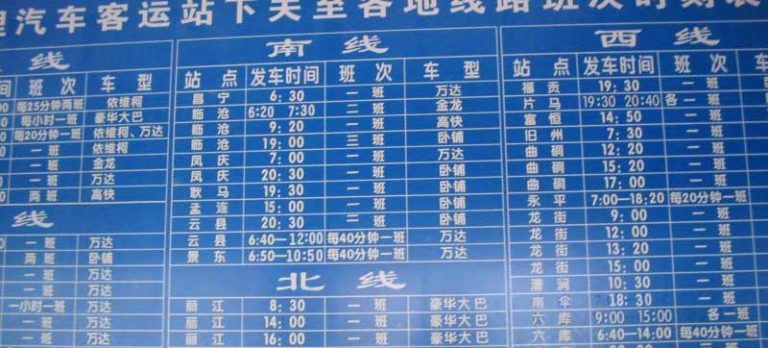
Example of a China bus schedule

In my opinion, the most confusing part about taking an intercity bus in China is figuring out the schedule. Unlike trains and airplanes, you can’t check schedules or even buy tickets online.
For most major intercity connections, China buses commonly depart once every twenty minutes, half-hour or hour. I’m making a major generalization here, I realize, but I’m assuming you’re not wanting to go to some po-dunk village that isn’t on any map.
There are some cases where only a handful or even one or two buses depart each day. In this case you’ll want to have an idea of the bus schedule. I’m going to separate the following recommendations by whether or not you can read Mandarin:
Yes, I Can Read Mandarin! Congratulations, your job will be a bit easier here. Most bus stations either post their schedule on the wall or have an LED board that lists destinations and departures to each city. Sometimes they are translated into English but often they are not.
Since you can read Mandarin, I assume you can also write/type as well. In this case, I’ve had moderate success looking up “[city] to [city] bus schedule” in Mandarin on baidu.com. The results aren’t always up-to-date, but you’ll at least get a general idea of when a bus should depart and how much it should cost.
No, I Can’t Read Mandarin. That’s ok, it’s really not a big deal. As I mentioned in an above chapter, you can always check out a good China travel guide book for bus schedules, although you should make sure that the book is the latest edition.
Other options include just asking the people at the bus ticket counter who can often show you on a computer screen the times of departure and how much a ticket will cost. Alternatively, perhaps your hotel or hostel can give you some good information.

How to Buy Bus Tickets in China

People standing in line to buy bus tickets in China

Since buying bus tickets online has not yet become an option, you’re left with only two options: buy a ticket at the bus station or (maybe) have a proxy do it for you.
China now runs on a “real-name ticket system,” which means that you have to have an official form of ID (your passport) in order to purchase bus tickets. Once your ticket is bought, you can’t transfer this ticket to anybody else without returning it and buying a new one.
Standing in line at a Chinese bus station isn’t my favorite activity in the world, but it’s usually not as bad as, say, standing in line at a train station. Most of the time I arrive on my day of departure, stand in line and purchase a ticket. You’ll want to have cash ready for the purchase since bank cards usually aren’t accepted – particularly foreign credit cards.
It used to be that hostels would offer a ticket purchasing service for guests (I’m not sure how many still offer this). You would need to provide a photocopy of your passport and they’ll charge you a fee, but at least you don’t have to stand in line yourself. An alternative would be to purchase tickets online with a service like www.chinabusguide.com. It’s easy to use but not every city in China is included.

China Buses: Frequently Asked Questions

Frequently Asked Questions

I’ve tried to provide as much information as I can in the above chapter, but I consistently receive questions that I want to answer here in detail.
What can you take on a bus?
The beauty of the Chinese bus is that you can take almost anything you want. People take bicycles, overweight pieces of luggage, instruments…you name it. There isn’t an official weight limit so whatever can easily fit in the underneath hatch is usually permitted.
What are you prohibited from taking on a bus?
Like any other form of transportation in China, there are still some things that you can’t take with you through the security checkpoint of the bus station. This includes: knives, bottles of any kind of liquid, fuel canisters (used for camping in China), lighters, etc. For drinks, you can buy water and sodas at shops inside the bus station.
Can you smoke on a China bus?
While officially prohibited, unfortunately I’ve seen plenty of passengers and even bus drivers smoke on a China bus. Most people wait for a rest stop to pull out their cigarettes but that’s not always the case. If you don’t like smoking, it’s not impolite to ask the smoker next to you to put out their cigarette. Be bold! You’re a foreigner and you can get away with it.
Are there electrical outlets on a China bus?
No. I wish there were but I have yet to see a seated or a sleeper bus with electrical outlets.
Can I get off anywhere along the bus route?
Yes, you can. Just tell the driver exactly where you want to get off (perhaps a specific village or place along the road) and they will stop to let you off.
Do buses pick up hitchhikers in China?
Yes, they do. If you’re out in the boondocks, you can stand on the side of the road and try to wave down a bus. They won’t stop if they’re full, but if they stop just tell them where you’re going on and hop on. You’ll have to pay the driver directly and they’re usually pretty good about giving a fair price for transport.

Bus Tips from a Seasoned China Traveler

Over the many years that I’ve taken buses all across China, there are a few quick tips I’ve picked up that I believe could be helpful to you or even save you money. Hopefully you find them useful!
  • Take the Night Bus: Want to save some money? Take the night sleeper bus to save yourself the money of a hotel. It won’t be as comfortable of a sleep but you’ll manage, I promise.
  • Take Your Own Food: The rest stops for buses can be sketchy at best. Food options are limited and the hole-in-the-wall restaurants are usually a recipe for disaster. Stock up on food before you leave to make sure you can survive on what you have in your own bag.
  • Keep Valuables Up Top: While I definitely recommend you store your luggage in the lower storage compartments, make sure you have all your valuables with you at your seat. I’ve known a couple people who have had items stolen from the below compartments.
  • Bring Your Own Light: This tip is for the overnight sleeper buses. Sometimes you’ll have a light to read by but many times you won’t.

Conclusion: Taking a Bus in China

That’s it! I hope you’ve found this guide to be helpful. I’ve thoroughly enjoyed the experience and adventure of taking a bus across China’s beautiful landscape and I hope you have the opportunity to do the same.
If you have any questions, please let me know in the comments below and if this has been useful please share this guide on Facebook, Twitter, Google+ or any other social media platform. Thanks!

Source

Tuesday, October 28, 2014

Rights and Duties in China

The General Principles of the Constitution of PRC: the People's Republic of China protects the lawful rights and interests of foreigners within Chinese territory, and while on the country's territory foreigners must abide by the law of the People's Republic of China.

Will my legitimate rights be protected in China?

Answer: Yes. Within Chinese territory, the legitimate rights and interests of the foreign visitors are protected.


Can I enjoy freedom in China?

Answer: Yes. The freedom of foreign visitors is as inviolable as that of the Chinese nationals. Within the period of their visas, foreign visitors can freely visit the areas open to foreigners. They should, however, respect the traditions and customs of local areas. Those who want to visit areas that are not open to foreigners should apply for a Foreigners Travel Permit from the local public security organ. Only after the approval is granted, can they enter the area legally.


Do I need to abide the law of China like the Chinese citizens, or are there special regulations for foreigners?


Tourists on Mt.Everest, Tibet
Visitors on Mt.Everest, Tibet
Answer: Similar to nationals, all foreign visitors must abide by the law of the People's Republic of China. Any activities that disrupt public order, threaten public security, or infringe upon the interests of the state; the society or the collective would be punished according to the laws of the country.


If I met something unfair in China, how can I protect my rights?
Answer: If your legal rights and interests are infringed or something unpleasant happens to you, you may complain to related organs.
Complain to the National Tourism Administrative Bureau directly or to the Institutions of Supervision over Quality in each province, when:
•Your travel agents, hotels or other travel operators offer you poor service or do not follow the agreement
•The guides or other travel staffs extort money from you
•You are injured or your baggage is damaged/ lost due to the fault of the travel operators
Also, all large tourist cities have hot lines for visitors to voice their complaints. Most of the complainants were satisfied with the verdicts, which were determined after thorough investigations and verification of facts.


Source

Related links

10 Reasons To Visit Los Angeles

10 Things Not to Do When Renting a Car

Using your credit and debit cards safely when traveling abroad

Women and Children Travelers to China

Traveling with children may be more challenging since they are inherently vivacious, mischievous, active and easily bored. Needless to say infants or toddlers, need much more special and attentive care, placing much responsibility on adults. So sometimes a trip with kids can be an interesting test of patience and preparedness. But never worry about this. China is always glad to extend a welcome to your lovely kids.
With the right preparation, travel with kids can bring you a happy and enjoyable experience. Here is some useful information for your reference to help to make your trip with children more enjoyable, comfortable and safe.

Before Departure

Familiarize yourself with the considerations that apply in respect of children when traveling, including the visa, passport, preferential measures and discounts on varied transport fares as well as the admission fees of the scenic spots.

Choose appropriate destinations that are suitable for both you and your kids to visit. The informative, educational and instructive showplaces that are full of history, culture and art, like China, may widen your children's field of vision and enhance their knowledge. Try to find information or collect some material related to your destination and introduce them to your kids, which may establish a good background for your kids to understand and enjoy the coming trip.

Choose the right time to visit. Kids tend to be active and adventurous so it is vital that you are able to exercise the right level of control over them. Infants may cause much more trouble. So an appropriate time to set out is very important. Try to select a time when children may sleep in transit. This will ensure not only your peace of mind but also that of fellow visitors.

Make a reasonable itinerary for your visit. Children lack the physical strength of adults, so your routes should not be very grueling or too long. Make your journey scheduling as flexible and relaxed as possible to ease pressure on your kids.

Private tour for mother and children, Li River, Guilin
Private tour for mother and children,
Li River, Guilin 
Pack your luggage well. Do not forget the things especially used for your kids including necessary clothes, food (some snacks and socks), toys, feeding-bottle (for infant) and a first-aid kit where some day to day medicines to deal with minor mishaps.

Make sure that your children are fit to travel; if there are problems, do follow the doctor's advice. If your visit is going to include physical activity, such as a fair amount of walking, practice before hand is recommended. Make sure that you have adequate health and travel insurances for your kids.

If possible, bring your baby-sitter or nursemaid as companions. They may be the very persons best suited to look after your children and so lessen any problems.

On Transport

Make sure you have already booked the train/air tickets especially for your kids at the required price. Contact the airport, airlines, or train stations as early as possible to tell the attendants your special needs and care for your children, so that they can make any relevant preparation in advance.

When you are on the plane, train or other transport vehicles, help your kids with the seat belt (infant should be held and carried in your arms or fixed on a special seating). Do not let them wander at will in the cabin or compartment to prevent possible injury or discomfort to other passengers.

Try your best to keep your children quiet. So in order to engage their attention, let them read books, listen to stories, and provide them with refreshment as appropriate.

Lodging


A family with our tour operators
A family with our tour operators
Contact the hotel in advance to ascertain the general condition of the guest room. Make sure all the facilities are accessible for children's use. If necessary, ask the hotel reception to arrange for special needs such as an extra bed or crib as well as the availability of child minding services.

Hide away any small gadgets, or dangerous items that may harm your kids. Be conversant with the hotel emergency procedures in the event of fire, etc.

Eating

When traveling, especially when going abroad there will be a change in diet. Children may not like the dishes on offer so you should consider their dietary needs with care. It is wise to ensure that they avoid unwashed fruit and the like as well as uncooked food and that you take all reasonable care to avoid stomach upsets.

Traveling 
Try to avoid visiting the more dangerous scenic spots as mountain and cliff footpaths, water in all its forms and areas such as jungle all present hazards. Pay much attention to your kid's movements. Keep them under your control and in view at all times.

Prepare some amusing games or small activities which may add some interest during trips and thus keep your children occupied.

Do not let them go out alone. Since travel destinations are usually unfamiliar to you, accompany your kids at all times as this is much safer. It is recommended that your kids carry a note of your name, telephone and address in their pocket in case they do get separated from you or become lost.

Source

Related links

10 Reasons To Visit Los Angeles

10 Things Not to Do When Renting a Car

Using your credit and debit cards safely when traveling abroad

Monday, October 13, 2014

Student Travelers to China

Nowadays more and more students are traveling abroad, and China is one of their favorite destinations to experience profound history and culture, as well as picturesque landscape. Going abroad can be expensive, so it is not unusual for students to travel on a budget. It can be a challenge to have a full and enjoyable adventure while trying to save money so we have put together a tip-list for students or any travelers who plan a budget tour:

Transportation is the most expensive aspect of any holiday, but proper preparation saves you money. Try to plan your trip early. As airlines usually release discount tickets several months in advance, so not only will have a wide range of destination choices you will get them at cheap rates. Airlines, such as Tiger Airways, Airasia, and Jetstar Asia for international flights in Asia, and Spring Airlines and West Air for domestic flights in China offer cheap tickets, but there will be extra charges for onboard services such as drink and meals.

Traveling by rail is always a good option for budgeting holiday makers. And for long-distance travelers, an overnight sleeper train ride cannot be better. It is cheap and comfortable, and also saves money on hotels. In China, train tickets are released 20 days in advance, and many are in great demand, so you’d better book all the tickets in advance.

Long-distance buses are available between cities and towns. Unlike trains running at fixed hours, buses are more flexible, departing every few minutes or hourly. In addition, you can reach some remote areas by buses. Tickets can be booked one to three days prior to departure. For some less popular routes, you can even buy tickets on the day of travel.

Public buses, subway, and taxies are the major transportation in cities. For visitors on a budget, public buses and subways are the best to save money. You can buy a transportation card for the city you are staying in which gives you discounts (at least 30% off) on bus and subway fares. This is especially recommended in large cities, like Beijing, Shanghai, Xian, and Guangzhou.

Hotels are another costly part. Inner city hotels or those near transportation hubs (airports and railway stations) and attractions are usually more expensive. The cheaper hotels are located on the outskirts of the cities; however, the money you save booking a cheap hotel may be taken up traveling to or from the attractions in the cities.

Hostels or youth hostels are popular among budget travelers, spending less for a bed and meeting interesting people. The facilities are not as good as those in hotels, but they are clean.

You may consider renting an apartment if you go with a group of people. Most apartments provide a washing machine and kitchen wares, so you also save the money on laundry and meals.

Couchsurfing is a new form of accommodation especially for student travelers. This is very popular in Europe and America, and is becoming more prevalent in China. You will get a free couch or bed, but the risk is that you live in a stranger’s home. If you are considering this then we recommend you do some research, there are couchsurfing websites, where people can post comments about the hosts.


Try to avoid traveling in peak season, especially during holidays. Holiday times in China as in most countries mean high hotel rates, expensive air fares, insufficient train tickets, attractions filled with people, and terrible transportation. What’s more, most attractions have different entrance fees for peak and low seasons. The travel peak seasons in this country are from April to November and the Spring Festival Holiday (late December to February).

Take advantage of the internet. Some attractions have discounted entrance fees if booked online, like the Window of the World in Shenzhen. Many travel websites and shopping sites also sell discount tickets for attractions. It is worthwhile to spending time doing some research.

Visit free attractions. Most museums in China are free to enter and these are good places for students to learn the history and culture of this country. Free parks, city squares, markets, and shopping malls are the best places to learn about and experience Chinese daily life.

Save money when you exchange currency. You can exchange some Chinese RMB in your country before leaving or withdraw cash from ATM machine after arrival (an extra service fee may be charged). The exchange counters in airports usually offer poor exchange rates.

Pack light and pack right. Cheap airlines charge for consigned luggage, so a light bag means you save money. Check the weather forecast before departure, and only take the necessary items with you.

International Student Identity Card holders may enjoy some discounts in shops, museums, hotels, and airlines in Hong Kong, Macau, and some cities in mainland China. Trains and attractions in mainland China do not offer discounts to international students.

Tips for safety:

1. Do not accept water or food from strangers.
2. Do not trust too “warm-hearted” people.
3. Avoid going out alone at night.
4. Do not touch anything you do not intend to buy.
5. Always take care of your purse and mobile phone.
6. Always carry a copy of your passport, visa, and other travel documents.
7. Keep a record of the telephone number of the embassy of your country.
8. Stay with your guide or teacher and tell them if you need to leave your group.

Source

Related links

Best Time to Visit China

15 Tips for Traveling in China

10 Best Cities to Visit in China

Sunday, October 5, 2014

Is it safe to travel to Hong Kong?

With an efficient subway, multiple inexpensive taxis and a good public bus system, Hong Kong is normally one of the world's easiest major cities to get around.

In the midst of this week's Hong Kong pro-democracy protests, however, travelers in Hong Kong may find moving around slightly more difficult than usual.
Since being occupied by demonstrators, access for vehicles is restricted in key areas of the city and many shops and restaurants in those areas have chosen to close.
Sections of major roads have been closed to vehicle traffic, though largely left open for pedestrians. In fact, walking around Hong Kong has been an extremely pleasant experience for a lot of visitors walking on roads that are normally jammed with cars.
After the clashes and tear gas attacks on protesters on Sunday night/Monday morning, the protests have been extremely peaceful and relatively festive.
However, the situation on the ground could change at any time and all visitors are advised to be appropriately cautious.
Several nations have posted travel warnings to Hong Kong with similar advisories.
Brief transport update:
  • Hong Kong International Airport is operating as per normal. The Airport Express train, stations and check-in services are also operating normally.
  • The MTR subway system is operating as normal and is the transport of choice at the moment as it serves all of the road closure areas.
  • Vehicular access is restricted or completely closed in parts of Wan Chai, Admiralty, Central, Mong Kong and Tsim Sha Tsui. Around 70 bus routes have been rerouted and around 25 services stopped. Check with hotel concierges and bus companies KMB, Citybus and NWFB for more details and advice on making your journey.
  • The Hong Kong tram track section between Western Market and Victoria Park (including the Happy Valley loop) has been suspended.
  • Visitors arriving at or leaving from hotels in affected areas should allow more time for their journey and be prepared to lug their baggage to MTR stations if buses, taxis and other road vehicle services cannot access the hotel.
In more detail:
Areas affected
In Hong Kong Island's Admiralty and Wanchai districts, Gloucester Road, Harcourt Road and Connaught Road Central have been closed to vehicle traffic, but remain open to pedestrians.
The area outside SOGO shopping mall in Causeway Bay, including Yee Wo Street and Percival Street remain closed but the demonstrators have agreed to reopen East Point Road as an emergency corridor for fire engines and ambulances.
The public square Edinburgh Place in Central is also a protest zone.
Various streets in these above areas have also been closed to vehicle traffic, but remain open to pedestrians.
Protests are also happening across Victoria Harbour in Kowloon, with sections of Argyle Street and Nathan Road in Mong Kok occupied by demonstrators.
Tsim Sha Tsui's popular shopping street Canton Road is also affected by the protest. A small crowd of a few dozen now occupy a section of the road. The crowd once peaked to a few hundred.
Hong Kong has its second public holiday in a row on Thursday and the size of the protests has increased over two days. The protest tends to grow at night, as more residents join after school, work or other activities.
It is also possible the protest groups may move or extend to other areas without notice.
'Protest tourism'
Hong Kong protest hotspots

Hong Kong protest hotspots
The protests have proven to be an attraction for some visitors.
Many tourists have taken to walking to and through protest zones independently, though tourists on private tours around protest areas have been seen.
Locals, tourists and supporters of the protestors have taken to "sightseeing" and looking for photo ops on elevated pedestrian bridges over roads near the Central Government Offices in Admiralty, where the largest protest (in terms of number of people) is taking place.
The idea of Hong Kong protests as tourist attractions might seem surreal, but it isn't entirely new.
In 2012, Lonely Planet included Hong Kong in its list of top 10 cities to visit, recommending such exotic attractions as the Star Ferry, Chinese fortune-telling and local protest rallies.
The popular guidebook called Hong Kong "China's most liberated city" and predicted that 2012 would be an exciting year for the city, highlighting its "rallies infused with theatrics and eruptions of song, dance and poetry" as it continued its push for greater democracy.
Safety concerns
Travel to and within protest areas is generally safe.
On Sunday evening and early Monday morning, police attempted to move crowds with force, including firing tear gas canisters. The protests have since been peaceful.
However, protestors continue to operate ad hoc supply depots at various points around and within protest zones, handing out water, towels and surgical masks to those wandering through the area as minimal protection against further potential uses of tear gas by police.
Supplies including food and umbrellas are also being given out to protestors and sometimes others entering protest areas.
Hong Kongers have their say on protests

Hong Kongers have their say on protests
Public transportation has also remained safe.

Wednesday, September 3, 2014

Best Time to Visit China


Climate Preference


China is a vast country with wide-ranging climatic conditions, so a decision about the best time to visit should be based on the regions you plan to visit and the kind of weather you enjoy.

Autumn

Normally, the most comfortable season of the year is early autumn (September to early October). During that period, temperatures are reasonable throughout China (about 50-72F) with a limited amount of rain. September for example is the only month in the year when the ancient and valuable paintings of the Beijing Palace Museum are displayed due to proper climate conditions (low humidity and proper temperature).

Spring

Spring can also be delightful with the average temperatures roughly the same as in autumn (about 50-72F). The best way to deal with weather unpredictability is to wear layered clothing that will make you comfortable in both chilly and warm weather.

Summer

Summer (from June to the end of August) can be extremely hot with temperatures well above 72F, especially in the famous 'four furnaces' of China: Wuhan, Tianjin, Chongqing and Nanchang.
Summer is also a rainy season, so visitors should not forget umbrellas, light raincoats and rubber/plastic shoes.

Winter 


Winter can be incredibly cold especially in the north. Off season visit can also offer its rewards. For example, the Harbin Winter Ice Lantern Festival is quite charming.

Before deciding when to pay a visit, it is worth checking carefully the China weather conditions of each city on the itinerary. Needless to say that the most attractive seasons to visit are also the most crowded. Regardless of the time of the year, a visitor will always be rewarded with charming scenery throughout the country.

High Season vs Low Season

High seasons in China:
• Labor Day (May 1, 3 days duration)
• National Day (October 1, 7 days duration)
• University Holidays: Summer holiday (June-September) and Winter holiday (January-February)

Many people plan a visit during high seasons. However it is not always the best choice. During high seasons tickets for trains, planes, as well as accommodations at hotels are hard to obtain, as great numbers of people travel during these times. It is highly recommended to join an organized tour if you must travel during high seasons, as doing so will certainly relieve you from the difficulties of obtaining tickets.


Compared with high seasons, low seasons couldn't be a better choice for visits. They offer you the following merits:

• Saving money. In low seasons, the related costs will be much lower than during the peak seasons. Entrance fees, travel ticket prices, and the goods sold in the places of interest will all cost less.

• Saving time. Low seasons offer you a more tranquil environment rather than a noisy, crowded place. It may take several hours to take a photo during peak time, while in low seasons you can enjoy yourself in the beautiful scenery without any interference.

Festival Preference

China is a great country with numerous nationalities and each nationality has their own festivals. Should you be a Chinese culture lover, come during the time the festival you wish to see is happening.  

Nearly each Chinese festival has its own legend and history. Please explore more details about Chinese festivals and determine your itinerary based on your favorite ones.

Saturday, August 30, 2014

10 Best Cities to Visit in China

At a time of economic recession, we fully appreciate that you are mindful of the costs associated with your vacation this year, and we are confident that you would not wish to waste your precious vacation time on a marginal destination. We at China Highlights have therefore selected for your consideration some of China's most popular destinations and China travel packages covering the places that represent the best value for the money.


1. BEIJING - Capital of China

the great wall

Beijing, China's capital city for over 700 years, is rich in history, both ancient and modern. Beijing is home to some of the finest remnants of China's imperial past, most famously the Great Wall of China, China's legendary line of defense; the Forbidden City, the largest and best-preserved ancient imperial palace complex in the world; the Temple of Heaven, fascinating site of imperial worship; and the Summer Palace, a lovely imperial garden. There is also Tian'anmen Square where the People's Republic of China was inaugurated by Chairman Mao.
Beijing has a glorious past, but is by no means stuck in the past. Standing side-by-side with old Beijing's crimson palace complexes are the city's modern buildings, the super-modern Olympic Village, with the Bird’s Nest Stadium and Water Cube; the dazzling shopping malls in Wangfujing Street and the colorful entertainment center of Houhai.
Despite all the changes in recent years, traditional lifestyle has been well-preserved in the oldest neighborhoods of the city - the Hutongs, which are mazes of narrow alleyways and old single-story traditional courtyard houses. A tour by rickshaw through the Hutongs will give travelers a glimpse of old Beijing.
Beijing is the must-see city for any visitor to China. As the political, cultural, and educational heart, as well as a key transportation hub of today's China and China in the past, it displays China's past, China today, and the direction in which China is heading in the 21st century.

2. SHANGHAI - China's Largest City

shanghai-bund-old-town-at-nigh

Shanghai, China's biggest and most prosperous city, oozes an atmosphere of vitality which can rival New York and Paris in terms of modernity. Shanghai is the second largest 'city proper' in the world after Mumbai. As one of the world’s leading economic and business cities, Shanghai's modernity is evidenced by the ambitious skyline in the Pudong Economic Zone and the gorgeous night scenes of the Huangpu River, when the spectacular lights of its immense towers dance in unison.
Shanghai's colonial legacy combined with things Chinese has created a unique culture, which is a fusion of the East and the West. The Bund, the waterfront of the city gives a vivid illustration of the combination of east and west cultures through its large collection of colonial architecture.
However, old Shanghai is not set to disappear overnight. Beneath Shanghai's impressive modern buildings and in the back alleys, scenes of the 1920s vision of the future have been kept.
Unlike Beijing, Shanghai does not brim with many great sights. Except for Yuyuan Garden, Jade Buddha Temple, the Grand Theater and the Huangpu River Cruise, there are no other sights with great appeal. However, the beauty of visiting Shanghai lies not in scurrying from sight to sight but in the feel of the city's modern atmosphere.

3. XI'AN - A Window on China's Ancient Civilization

xian the terra-cotta warriors and horses

As the second most famous of China's ancient national capitals (after Beijing), Xi'an was the first capital of a united China in 221 BC (the Qin Dynasty). It also served as the capital during the golden eras of the Han Dynasty (206 BC - 220 AD) and the Tang Dynasty (618 - 907).
Thus Xi'an is blessed with a great number of precious relics and historical sites, with the highlights being the Entombed Warriors (a contender for the eighth Wonder of the World), the First Emperor's Tomb, two historical Buddhist Pagodas (Big Wild Goose Pagoda and Small Wild Goose Pagoda), the Great Mosque, the Ancient City Wall and the Banpo Site (a prehistoric civilization museum).
Xi'an was also the starting point of the Silk Road, an ancient trade route that extended from Asia to Europe and played an important role in economic and cultural exchange between the East and the West in ancient times.
Xi'an is, for certain, one of the most popular tourist destinations among foreign travelers, and so is included in the itineraries of many of our tour packages. At China Highlights, we feel that a tour to Xi'an is something that any tourist to China would not want to miss, as it serves as a window on China's ancient civilization.

4. GUILIN - The Most Beautiful Place in China

xingping

Guilin, with its marvelous limestone scenery, is renowned as one of the most beautiful places on earth. During his visit, former US President Nixon was inspired by Guilin's picturesque natural scenery and remarked: "I have visited more than eighty countries and over a hundred cities. I have found that no city can surpass the beauty of Guilin.” The city, nestling among the vegetation-clad pinnacles on the banks of the Li River seems to belong to a landscape painting.
Guilin City is in the center of two tourist honey pots (each about 1 hour 30 minutes by bus): Yangshuo and Longsheng, which are renowned for their beautiful scenery. Yangshuo in particular has become a paradise for backpackers, with its idyllic countryside, its easy-going atmosphere, and its Western food and beer. Longsheng is famous throughout China, if not throughout the world, for the scenic beauty of its terraced rice paddies, and for its Zhuang and Yao ethnic culture.
Guilin is a well-developed tourist city, with a plethora of retail shops that are tourist-friendly and a string of excellent hotels.
Guilin is due west from Hong Kong, from which it can be reached by air in an hour. A tour of Hong Kong can be easily combined with a Guilin tour .

5. HONG KONG - The Oriental London

victoria peak

Hong Kong is not like any other place on earth. As one of the most important economic and financial centers in East Asia, Hong Kong enjoys all the benefits of a dynamic and vibrant metropolis. While definitely Chinese it still enjoys a good measure of independence.
Hong Kong is a fusion of cultures. Remnants of its colonial past, British culture, and values share space with Chinese tradition. Once known an exotic port for Eastern trade, it is now famous for its movies.
Hong Kong is a world-renowned shopping paradise, known for its tourist-friendly atmosphere and numerous options. The huge shopping malls of Central, Admiralty and the street fashion factory in Causeway Bay are reasons for many travelers to make their Hong Kong trips.
Hong Kong also has some amazing beaches and natural sights for outdoor lovers. Lantau Island for example, provides a relaxing atmosphere for a holiday break.
Words fail to convey the essence of Hong Kong. If you want to appreciate this "Oriental London ", visit Hong Kong with your eyes and ears open. Check Hong Kong Tours

6. Hangzhou - Heaven on Earth

the west lake

When Marco Polo came to Hangzhou in the 13th century, he declared it “the most beautiful and elegant city in the world". There is a popular Chinese saying: "Above there is heaven, below there are Hangzhou and Suzhou." Hangzhou's "heavenly" beauty attracts hundreds of thousands of tourists to its exquisite West Lake (Xi Hu) area each year to enjoy the placid lake, beautiful gardens, reflecting pools, lavish temples and lakeside teahouses.
There are many well-known historical and cultural sites around West Lake area, such as Lingyin Temple and Six Harmonies Pagoda. You can also combine a Hangzhou Tour with visits to the nearby water towns like Xitang and Wuzhen. Thousand Islets Lake and Mt. Mogan Scenic Area are also ideal weekend getaways. The most famous products of Hangzhou are silk and tea. No wonder China's National Silk Museum and National Tea Museum are all located in Hangzhou. At the tea plantation located in the hills near West Lake, visitors can learn about the processing procedures for tea and watch a traditional tea ceremony. Check Hangzhou Tours

7. Chengdu - Hometown of Giant Pandas

panda breeding and research center

Chengdu is the hometown of Giant Pandas. Visitors can see Giant Pandas at Chengdu Giant Panda Breeding and Research Center, or take part in volunteer program at Bifengxia Giant Panda Base. Besides, there are many historical sites, such as Sanxingdui Ruins Museum, Qingyang Palace and Mount Qingcheng. To experience the leisurely local life, visit the Wide and Narrow Alleys, Wangjiang Park and Jinli Old Street, or sip tea while watching the magical face changing of Sichuan Opera.
Chengdu is more than 2,000 years old. Chengdu has been a famous cultural center with age-old colorful traditions of both religious and civil significance. Home of poets of old and spicy Sichuan food, Chengdu has also become a popular place for Westerners to reside.

8. Huangshan - Magnificent Beauty

yellow mountain winter

Huangshan (the Yellow Mountains) is surely the most famous and most photographed and painted mountainous region in China. It was listed as a World Heritage Site by UNESCO in 1990.
Outstanding natural beauty is Huangshan's number one feature. Austere and majestic clean rock faces rise sheer among the mists, clung to by the hardiest of pines. This is the scenery of legends. Indeed it is said that China's supernatural ancestor, the Yellow Emperor, lived here.
The Yellow Mountains' classic four attractions are curiously-shaped pines, oddly-shaped rocks, the seas of clouds, and hot springs. There are hundreds of peaks and thousands of ravines, many made accessible by well-worn steps. Lotus Peak, Bright Summit, and Heavenly Capital Peak are the three major peaks, all rising more than 1,800 meters (5,900 feet) above sea level.
Nearby attractions not to be missed: Xidi Village and Hongcun Village present ancient China’s elegance and tranquility with well-preserved ancient folk houses and flowing rivers. Xin'an River is a recent popular hiking destination, while Tachuan Village’s autumn scenes are among the best in China.

9. Lhasa - Holy Pilgrimage Destination

potala palace

Located at an altitude of 3,700 meters and with more than 3,000 hours of annual sunshine, Lhasa is famed as the “City of Sunshine”. It is the center of Tibet’s political, economic, cultural and religious activities.
More than 80% of the population is Tibetan, so the Tibetan influence is strong and evident. In Tibetan language, the name of "Lhasa" means "Land of the Gods".
There are many historic sites and famous relics in the city proper and its suburbs, among which the Potala Palace, Jokhang Temple, Drepung Monastery, Sera Monastery and Norbulingka are world famous. At Barkhor Street, visitors can go souvenir hunting, rub shoulders with locals, and experience the sacred "one step one bow" way to religion.

10. Lijiang - Old Ethnic Town

shuhe ancient town

Three ancient districts of the city of Lijiang became a UNESCO World Heritage area in 1997. There are interesting historical sites dating back hundreds of years interspersed with high mountains, forests, wild rivers and streams.
It is the home of 12 ethnic groups, among which the Naxi ethnic group takes up more than half. The Naxi’s architecture, ancient water system, and culture are popular points of interest.
The Yangtze River passes through this area, and Tiger Leaping Gorge is a beautiful sight and a popular hiking route. The Yulong (Jade Dragon) Snow Mountains above are sacred to people in Lijiang.

Source


Related links:

Best Tour Destinations - Travel China Guide

9 eateries of Thailand 

Thailand Travel Tips


Friday, August 29, 2014

Thailand Travel Tips


Travel to Thailand is easy with flights to Bangkok’s Suvarnabhumi airport leaving daily and a wide choice of airlines to get you there.  Chiang Mai, Phuket and Hat Yai airports also have immigration facilities and a small number of scheduled international flight arrivals.  Check out the cheap flights to Thailand or call us about getting a Round the World ticket with a stop in Thailand.

Thailand airports
Suvarnabhumi airportBangkok is home to two airports.  The new airport, Suvarnabhumi, opened in 2007 and is located in Racha Thewa around 30 kilometers east of Bangkok.  There are various forms of transport to and from this Bangkok airport including shuttle bus, public bus and car rental.  Usually the higher end hotels will send a representative to meet you at the airport but most visitors take a metered taxi – there is a 50 baht airport surcharge on top of your fare (which should only be a few hundred baht) plus you’ll need to pay express way fees.  The journey is usually 40 minutes to an hour depending on your destination.

Don Muang airport

Some domestic flights still operate out of the old international airport, Don Muang (24 kms north from Bangkok), so check your ticket carefully so you’re definite about which airport you should be at.  The same transport options exist out of Don Muang as they do at Suvarnabhumi and the travel time is slightly less.

Phuket airport

Phuket Airport is one of the busiest outside Bangkok.  You can get a cab, mini-bus or public bus to your destination.  Average taxi fares from the airport are a little more costly than the other airports – around 400 baht to Phuket (30 minute journey), 550 baht to Patong (40 minute journey) and 650 baht to Kata/Karon (around a one hour journey).

Chiang Mai airportChiang Mai airport is 10 minutes from the city centre and there are taxis, songteaws (an open-back taxi truck) and tuk-tuks ready and waiting.  A taxi trip will cost around 120 baht to most destinations in the city.  Many hotels will arrange free transfer to and from the airport so check with your hotel to see if they provide this service.

How to get around

Travel in BangkokThere are tons of Thailand transport options to suit all budgets and comfort levels – if you’re travelling through Bangkok the sky train is an excellent way to get around – both cheap and fast (avoid that traffic!).  Otherwise you can jump in a taxi (make sure you ask for the meter to be turned on, otherwise risk paying an inflated price) or there are plenty of tuk-tuks to take you on a fun ride.  Be sure to agree on the price before heading off and ask for a direct route or you may find you make some unscheduled stops where the driver will collect commission – this goes for both tuk-tuks and taxis.  Another novel way to see the city is to jump on an extremely cheap public bus, or head down to the Chao Praya River and get on a tourist boat or river taxi.

Travel outside of Bangkok

Travel outside Bangkok by flying into one of the domestic terminals, or take a train or bus if you’re on a budget.  You can jump on a boat to get across to the islands, and once you are there, hire a motorbike, jeep or pushbike, or catch a songtaew.  If you’re going to hire a motorbike make sure a helmet is included and cover up if you can - motorcycle accidents and injuries are so common that in Koh Phangan for example, the characteristic road burn is known as a 'Koh Phangan tattoo.'

Organised tours Organised tours are a great way to see the sites and soak up the local culture – especially if you’re travelling alone or are a first-time traveller.  Check out some of the options for tours and treks in Thailand.

Source


 Best Tour Destinations - Travel China Guide

 20 Reasons to Drop Everything and Go to Spain

Tips on How to Travel Europe


Thursday, August 28, 2014

Best Tour Destinations - Travel China Guide

China is so large. Going to China for traveling, you will have many destinations. Some destinations are renowned for its history; some boast picturesque landscapes; some are endowed with very colorful ethnic features; and some are economically prosperous.

The Most Popular Destinations in China

Beijing, Shanghai and Xian are very famous Chinese cities in the world. Beijing, capital of the country, is the center of the country's political, economic, cultural and educational center; Shanghai is a well-developed metropolis with prosperous economy; Xian, the ancient capital of 13 dynasties, possesses abundant historical heritage.

Besides, you may go to visit Shenzhen, Guangzhou, Hangzhou, Suzhou, Guilin, Lijiang, Jiuzhaigou, Sanya, Tibet or Xinjiang. Shenzhen and Guangzhou are well-known coastal cities with fast economic development; Hangzhou and Suzhou boast beautiful water towns, lakes and gardens as well as favorable climate; Guilin, Lijiang and Jiuzhaigou are famed for unique natural scenery, and characteristic ethnic minorities' culture; Sanya in Hainan Province makes you enjoy the charming tropical scenery; Tibet has mysterious religious beliefs, vast grasslands and highest mountains; and Xinjiang attracts visitors by its various ethnic minorities and numerous historical relics along the Silk Road.
Mountain Climbing


There are  many mountains on the land of China. The most notable ones are the world's highest Mt. Everest and the five sacred mountains, namely the Mt. Taishan in Shandong, Mt. Huashan in Shaanxi, Mt. Songshan in Henan, Mt. Hengshan in Hunan and Mt. Hengshan in Shanxi. Additionally, the Mt. Huangshan in Anhui and the Mt. Lushan in Jiangxi are well worth a visit.

River Cruises
The Yangtze River is the first longest river in China. A Yangtze River cruise is a memorable experience. You can get on the ship at Chaotianmen Port of Chongqing to start the downstream cruise from Chongqing to Yichang, Wuhan or Shanghai, or you can choose to go upstream. What's more, in Guangzhou, you can join the Pearl River night cruise; in Guilin, you are suggested to have a Li River cruise. The on-board vacation is interesting and relaxing.

Great Wall Trekking


Great Wall of China is amazing. Its remains can be found in Gansu, Ningxia, Shaanxi, Inner Mongolia, Shanxi, Hebei, Beijing, Tianjin, and Liaoning. If you want to have a Great Wall hiking tour, Beijing, Tianjin and Hebei are highly recommended. Especially, the Badaling Great Wall in Beijing, the Huangyaguan Great Wall in Tianjin and the Shanhaiguan Pass in Qinhuangdao (in Hebei) are must-sees. Additionally, the Jiayuguan Great Wall in Gansu is a good choice.

Silk Road Adventure
If you take a great interest in the history of the Silk Road, why not have a Silk Road adventure Xian will be your first stop as it once was the beginning of the Silk Road in the history. Set off towards Gansu and then Xinjiang. During this visit, you can find many historical sites, such as the ruins of ancient kingdoms, museums, architectures and tombs. Also you can hear lots of interesting stories like the decline of Loulan Ancient Kingdom and the construction of Bajiao Ancient City.


Ancient Towns Visiting


There are many ancient towns in China. Mostly, the ancient towns have well-preserved ancient buildings and also keep a traditional life style. The notable ancient towns include Fenghuang (in Hunan), Songpan (in Sichuan), Pingyao (in Shanxi) and Lijiang (in Yunnan).

Other Featured Tours
If you want a featured tours, you may go on a visit to Guizhou and Yunnan, which are inhabited by many ethnic minorities. In Guizhou, you can visit Guiyang, Kaili, Tongren and Bijie. In Yunnan, Kunming, Dali, Lijiang, Shangri-La and Xishuangbanna are must-see destinations.

Another kind of featured tours is coastal cities tours. You can go to Qingdao, Yantai, Weihai, Dalian, Qinhuangdao and Xiamen.


Tips on How to Travel Europe

20 Reasons to Drop Everything and Go to Spain


5 Reasons Why Travel with Kids Creates a Better Traveling Experience


Wednesday, August 27, 2014

Shopping in Kyoto, Tokyo


Tokyo may be the capital of but Kyoto is the country's cultural and artistic heart, with traditional shops dedicated to particular crafts. Many are family owned, some having provided shoppers with a unique glimpse of history for 10 generations.

Shoyeido (Karasuma-dori, Nijo-agaru, Nakagyo-ku, tel: 81 75 212 5590) is
's oldest incense-making company. You'll have no problem finding the shop: just follow the delicate sandalwood fragrance to the treasure trove of incense sticks, cones, coils and wood-chips. Shoyeido's master blenders use centuries-old recipes from the Imperial Palace passed down through 12 generations of the same family. The refined incense is unique, thanks to the family's insistence on using the finest natural products and hand-preparing each blend. Exquisitely designed incense stands cost from 500 yen each ($32.50). The uninitiated should try the Incense Trial Set (1,500 yen), which includes three sticks each of 10 different fragrances. A box of 20 sticks of the same fragrance costs 800 yen.

Look no further for Zen-like beauty than the many Yojiya cosmetics shops (see www.yojiya.com for locations). It was an absolute mad house the last time I was there so you’ll have to elbow your way past droves of Japanese women to stock up on Yojiya's most famous product, Aburatorigami, the secret to a perfect matt complexion. The velvety oil-blotting facial paper was originally used by geishas and now holds cult status in
(3,360 yen for 10 booklets containing 20 sheets each). Yojiya's deep moisturising travel hand cream is an excellent buy at 400 yen.
 
Protect yourself from the midday sun or showers with a beautifully decorated umbrella (wagasa) from Tsujikura (Shijo-agaru, Kawaramachi-dori, Nakagyo-ku, tel: 81 75 221 4396). The bamboo and paper umbrel-las are made in Kyoto by master craftsmen and are available in small sizes for children (4,000 yen) as well as vast, decorative versions worthy of a hotel foyer. Prices rise according to size and intricacy of decoration, but a medium-sized umbrella costs no more than 6,000 yen. Tsujikura also sells an impressive range of handmade paper lanterns, from traditional round items to more contemporary styles by Osamu Noguchi. Children will love the miniature toy lanterns and umbrellas, which make inter-esting souvenirs and cost less than 1,000 yen.

Next, head for the hallowed halls of Miyawaki Baisen-an (Tomino-koji, Nishi-iru, Rokkaku-dori, Nakagyo-ku, tel: 81 75 221 0439), which has been making Japanese fans since 1823. This is not a shop for the budget con-scious, with prices starting at 3,000 yen and specially decorated fans costing from several hundred thousand yen - but the quality is outstanding.

For a unique buy, visit the indigo-dyeing workshop of Aizen Kobo (Nakasuji-Omiya Nishi, Yoko-omiyacho, Kamigyo-ku, tel: 81 75 441 0355). Aizen Kobo uses traditional Japanese methods to achieve intense blue dyes and is the acknowledged world specialist in this time-consuming hand-dyeing technique. Levi's has sent observers to learn from this master, and the
British Museum has a collection of his works. Although larger items are expensive, the indigo colours never fade. A decorated noren (a traditional split-curtain hung in doorways) costs from 150,000 yen, while a kimono-style jacket costs from 300,000 yen. The shop also sells a range of smaller items such as table-mats (3,000 yen each) and toy animals (1,000 yen each).


Thursday, August 14, 2014

Required Health and Vaccine Information for Travel to South Asia

If you’re planning to travel to South Asia in the next coming months, you should understand the following health information. The East Asian region consists of , , , , , , and .

As with travel to any country or region, you should make a point to obtain all routine vaccinations before your travel. To provide further health protection during your upcoming travels it is also a good idea to see your doctor before your trip. Ideally, you should make your visit to your physician at least 4-6 weeks before traveling. This will allow sufficient time for your injections to become effective. In the event that you plan to leave in less than four weeks time, it is still a good idea to go ahead and see your physician.

When traveling to South Asia, you should plan to have the following vaccines. Be sure to discuss your travel plans with your health care professional in order to determine whether there might be any additional vaccines you may need.

Hepatitis A-This vaccine is also known as the immune globulin (IG) vaccine. It is important to know that transmission of hepatitis A virus can occur from direct in person contact as well as exposure to water, shellfish or ice that has been contaminated or polluted. Further transmission can occur from consuming foods such as fruits, vegetables and other foods that have not been cooked or that were contaminated or polluted during harvesting and/or handling.

Hepatitis B-You may be exposed to this disease by coming in contact with body fluids or blood. Transmission can also occur through sexual intercourse with locals or through medical treatment.

Malaria-You should be aware that the risk of malaria can be high even in cities in South Asia. You can obtain an anti-malarial drug from your health care professional to avoid contracting this disease. Remember that you should continue to take the ant-malarial drugs even after leaving high risk areas, as directed by your physician. Symptoms associated with malaria can occur for up to one year following exposure. In the event that you experience fever or symptoms similar to the flu, make a point to see your physician immediately and let them know about your travels to high-risk areas.

Rabies-Take precaution by obtaining a pre-exposure vaccination. This is especially important if you will be in the outdoors in the South Asian region for extended periods of time.

Japanese encephalitis-This is an important vaccine to obtain if you plan to visit rural areas where Japanese encephalitis has been known to experience outbreaks.

Typhoid-This disease may be contracted when you come in contact with contaminated food or water. Be aware that consuming beverages or food that have been handled by an infected individual can also cause you to contract the disease. Avoid foods sold by street vendors. Be especially aware of the fact that some strains of typhoid have been reported to be resistant to numerous antibiotics in the West Asian region, particularly and .

Other vaccines which you may need to obtain, as needed, include booster shots for tetanus-diphtheria, measles and polio.

source

Required Health and Vaccine Information for Travel to East Asia


If you’re planning to travel to East Asia in the next coming months, you should understand the following health information. The East Asian region consists of  Macau SAR and Hong Kong SAR.

As with travel to any country or region, you should make a point to obtain all routine vaccinations before your travel. To provide further health protection during your upcoming travels it is also a good idea to see your doctor before your trip. Ideally, you should make your visit to your physician at least 4-6 weeks before traveling. This will allow sufficient time for your injections to become effective. In the event that you plan to leave in less than four weeks time, it is still a good idea to go ahead and see your physician.

When traveling to East Asia, you should plan to have the following vaccines. Be sure to discuss your travel plans with your health care professional in order to determine whether there might be any additional vaccines you may need.

Hepatitis A-This vaccine is also known as the immune globulin (IG) vaccine. It is important to know that transmission of hepatitis A virus can occur from direct in person contact as well as exposure to water, shellfish or ice that has been contaminated or polluted. Further transmission can occur from consuming foods such as fruits, vegetables and other foods that have not been cooked or that were contaminated or polluted during harvesting and/or handling.

Hepatitis B-You may be exposed to this disease by coming in contact with body fluids or blood. Transmission can also occur through sexual intercourse with locals or through medical treatment.

Malaria-You should be aware that the risk of malaria can be high even in cities in East Asia. You can obtain an anti-malarial drug from your health care professional to avoid contracting this disease. Remember that you should continue to take the ant-malarial drugs even after leaving high risk areas, as directed by your physician. Symptoms associated with malaria can occur for up to one year following exposure. In the event that you experience fever or symptoms similar to the flu, make a point to see your physician immediately and let them know about your travels to high-risk areas.

Rabies-Take precaution by obtaining a pre-exposure vaccination. This is especially important if you will be in the outdoors in the East Asian region for extended periods of time.

Japanese encephalitis-This is an important vaccine to obtain if you plan to visit rural areas where Japanese encephalitis has been known to experience outbreaks.

Typhoid-This disease may be contracted when you come in contact with contaminated food or water. Be aware that consuming beverages or food that have been handled by an infected individual can also cause you to contract the disease. Avoid foods sold by street vendors.

Other vaccines which you may need to obtain, as needed, include booster shots for tetanus-diphtheria, measles and polio.

source

Required Health and Vaccine Information for Travel to Southeast Asia


If you’re planning to travel to South Asia in the next coming months, you should understand the following health information. The Southeast Asian region consists of , , , the , , , , , , and East Timor.

As with travel to any country or region, you should make a point to obtain all routine vaccinations before your travel. To provide further health protection during your upcoming travels it is also a good idea to see your doctor before your trip. Ideally, you should make your visit to your physician at least 4-6 weeks before traveling. This will allow sufficient time for your injections to become effective. In the event that you plan to leave in less than four weeks time, it is still a good idea to go ahead and see your physician.

When traveling to Southeast Asia, you should plan to have the following vaccines. Be sure to discuss your travel plans with your health care professional in order to determine whether there might be any additional vaccines you may need.

Hepatitis A-This vaccine is also known as the immune globulin (IG) vaccine. It is important to know that transmission of hepatitis A virus can occur from direct in person contact as well as exposure to water, shellfish or ice that has been contaminated or polluted. Further transmission can occur from consuming foods such as fruits, vegetables and other foods that have not been cooked or that were contaminated or polluted during harvesting and/or handling.

Hepatitis B-You may be exposed to this disease by coming in contact with body fluids or blood. Transmission can also occur through sexual intercourse with locals or through medical treatment.

Malaria-You should be aware that the risk of malaria can be high even in cities in Southeast Asia. You can obtain an anti-malarial drug from your health care professional to avoid contracting this disease. Remember that you should continue to take the ant-malarial drugs even after leaving high risk areas, as directed by your physician. Symptoms associated with malaria can occur for up to one year following exposure. In the event that you experience fever or symptoms similar to the flu, make a point to see your physician immediately and let them know about your travels to high-risk areas.

Rabies-Take precaution by obtaining a pre-exposure vaccination. This is especially important if you will be in the outdoors in the Southeast Asian region for extended periods of time.

Japanese encephalitis-This is an important vaccine to obtain if you plan to visit rural areas where Japanese encephalitis has been known to experience outbreaks.

Typhoid-This disease may be contracted when you come in contact with contaminated food or water. Be aware that consuming beverages or food that have been handled by an infected individual can also cause you to contract the disease. Avoid foods sold by street vendors.

Other vaccines which you may need to obtain, as needed, include booster shots for tetanus-diphtheria, measles and polio.

Sunday, August 10, 2014

Great Wall Tour Tips


'He who does not reach the Great Wall is not a true man', as this famous Chinese saying goes, the Great Wall of China, a great engineering marvel, always attracts throngs of adventurous tourists from all over the world.

Whenever you see this venerable Great Wall, you must feel deep esteem. If you are planning long haul travel to it to look in depth upon this the world's greatest feat of engineering, some of the must-know facts below may be helpful in preparation for your exploration.

 Which Section to Choose 

Besides the touristiest Badaling and Jinshanling, Mutianyu, Simatai, Gubeikou in Beijing, the Chinese government has also opened other sections to visitors, such as Huangyaguan in Tianjin, Shanhaiguan in Hebei Province and Jiayuguan in Gansu Province. However, visiting all of the sections is virtually impossible unless you have all the means and time at your disposal. Below are the four most popular sections in Beijing:

Beijing Great Wall crowded with tourists
Beijing Great Wall Travel
 Badaling - This is by far the most representative and probably most famous. It is the grandest and most splendid section of all, closest to Beijing city proper, convenient to access and easier to climb, thus the most visited. However, it always swarms with tour groups, individual tourists and hawkers, which may affect your photography and ease with which to enjoy the views. Badaling has the most renovation and is well managed and consequently, much safer to walk along than other sections.

 Mutianyu - This is the second most redeveloped section after Badaling, with high forest cover and remarkable views in fall and summer. It is steeper than Badaling but less congested by tourists, souvenir sellers and especially pickpockets. Here you will find a truly mind blowing experience.

 Simatai - If you fancy an adventure, it is better to visit Simatai, which has had less renovation yet is well preserved. As well as its ruins, it also has an intact section, so Simatai is considered by many tourists from home and abroad as the best section of the Great Wall. Specifically, the eastern part of Simatai is more challenging while the western part is much easier to climb. Here you will seldom encounter vacationers. However, elders and those who are not in good physical condition are advised not to climb this section in view of its cragginess.
Jinshanling - the section that is completely un-restored, with almost no crowds and hawkers, but more steep, which is favored by most foreign travelers.

In short, Badaling is ideal for most tourists in view of its accessibility, but it is unavoidably crowded and touristy. Do not go there if you have another choice. Mutianyu and Simatai are the two best ones. Also you can head further afield to Juyongguan, Huanghuacheng or Jiayuguan parts, there you will find no noisy souvenir and food sellers, group travelers, just the great wall, locals and some adventurers like yourself, which may in itself present a challenge.
 Best Time to Visit
Great Wall travel
Climb Watchtowers
The scenery of the Great Wall varies with the seasons, which offers many features and fodder for photographers who seek to obtain characteristic photographic works at any time of the year. However, if you are an ordinary visitor, the best times are spring and autumn, especially May, September or early October when it is usually sunny, with brisk temperatures, leaving you more refreshed and comfortable.

Although it is hotter, June to August is an alternative, as the tourist season is in full swing. November to April is always bitterly cold with biting winds, when the Great Wall encounters few, if any, tourists.

What to Pack
  Clothing
The temperature variation between day and night along the Great Wall is obvious. TravelChinaGuide suggests a loose cotton T-shirt and a loose trousers rather than denim. However, if you go there in summer, wear shorts for daytime hiking and put on warm clothes such as jacket or sweater in the evening for you will feel somewhat cool, particularly in autumn. Good advice if you are to avoid catching cold.

Due to the steep inclines along the wall, trainers may be a good choice for shoes. Never wear high heels or you will quickly suffer from fatigue and in any event, they are hazardous in such locations. Anyway, make yourself as comfortable as possible.


 Food and Drink
Your hike may last for 2-3 hours. Take some snacks along, while a good supply of water is necessary to avoid dehydration. These can be purchased on the Badaling section but at a possibly unexpected higher price. Remember, there are no sales on other sections. However, do not drink too much water for there are no washrooms midway only those around the ticket office and the entrance.


 Health and Safety
Have a rest on Great Wall
a. Carry an umbrella to protect you from the sun as well as potential rainfall.
b. Anoint yourself with some sunscreen and wear sunglasses to avoid the harm from strong ultraviolet radiation.
c.  Please inquire about the weather condition before traveling. Do not visit the wall on rainy days. In case it rains while you are on the wall, do not use cell phone, broadcast or any other communication equipment. Turn their power off and take shelter in a beacon tower to avoid lightning strike.
d. As it is always dry in spring, autumn and winter, moisturizer may be helpful to moisturize your skin.
e. It is quite windy in spring, autumn and winter, especially on the Great Wall due to its high altitude, so scarves can be warm and windproof to protect your face.
f. Some sections of the wall are very steep but still can be manageable, use the handrail.
g. Do not be bold to climb the undeveloped sections where the areas are insecure or damaged, or you may injured by the breakage of the wall.
h. Carry some medicines such as remedies for cold, carsickness and some Band-Aids so that they are readily available should the need arise.

 Other Travel Tips

a. Get up in the early morning at about 07:00 to catch the first official tourist bus to arrive at the Badaling around 09:00-10:00 to avoid the large crowds of tourists, and thus you can get an early return to the city proper in the evening.
b. For travel to Badaling , you can also hire a taxi and have a round trip journey for about CNY400.00 according to the taxi type and your negotiation with the taxi driver.
c. Allow two to three hours for your visit when in Badaling section.
d. Cable cars are only available in Badaling, Mutianyu, Simatai and Jinshanling sections.
e. You should be aware that noisy hawkers could be a problem on the wall.
f. Learn more of the culture and history of the Great Wall before your hiking trip, to have a more informed experience.
g. For protection of this world heritage, graffiti is not allowed on the wall.
h. Please leave no litter on the wall, there are waste bins provided.

From this